Oriental Shorthair Insurance, Care and Health Advice
After World War II, many cat breeds were at risk of extinction. To revive the Siamese cat breed, English breeders included Russian blues, Abyssinians, and British shorthairs into their cat breeding programmes. Pointed kittens were used to widen the Siamese breed gene pool. Each non-pointed kitten was named as a separate breed, but due to the wide variety of colour combinations, it was easier to classify them as 'Orientals'. Today we have the Oriental Shorthair - playful, talkative and inquisitive cracker of a cat. Let's learn more.
Oriental Shorthair Facts


Is a Oriental Shorthair Right for Me?
The Oriental Shorthair's characteristics make it well-suited to those seeking an active, intelligent, and friendly companion. They're best suited to experienced owners and homes with adults or older children, as they always want lots of attention.
Despite being noisy themselves, they prefer a calm environment. They love to supervise from a high viewing point and will always offer a paw to help you with whatever you're doing. If you have lots of love and time to give, this is the breed for you!
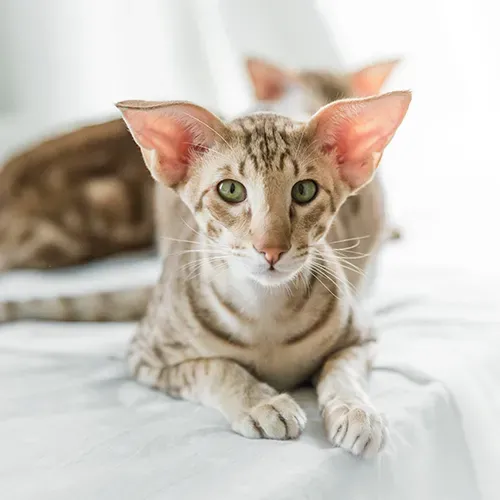
After the breeding of Russian Blues, Abyssinians, and British Shorthairs post WWII, 'Orientals' now come in over 300 coat colours and patterns, including white, black, blue, chocolate, caramel, fawn, lilac, cream and seven tortie colours.
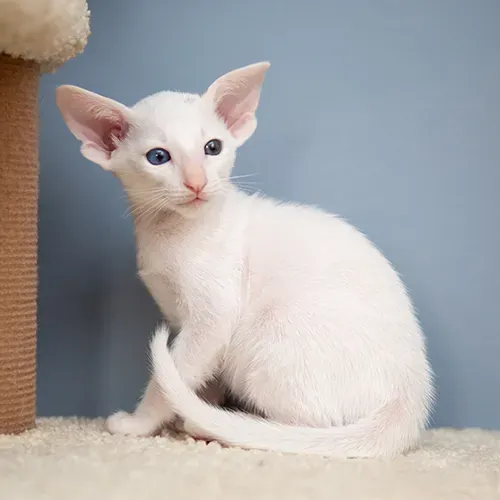
Patterns include solid coloured, smoke, spotted, and a variety of tabby. They usually have green eyes, except for white coats, which have blue eyes. Initially, the breed was only short-haired, but further crossbreeding led to Oriental longhair varieties. So, if you fancy one of these endearing little chatterboxes, you can pretty much choose your style!
What are Oriental Shorthair Kittens Like?
Oriental Shorthair kittens are inquisitive, noisy, and love to play, and this doesn't change as they get older. They're very sociable and talkative, holding a conversation with lots of meowing and chirping.
Like their Siamese ancestors, they have high energy, bond well with family members, and thrive on lots of attention and affection. They'll happily be a lap cat and like to sleep next to their owner in bed. They make great companions for other cats or even cat-friendly dogs.
Life with an Oriental Shorthair
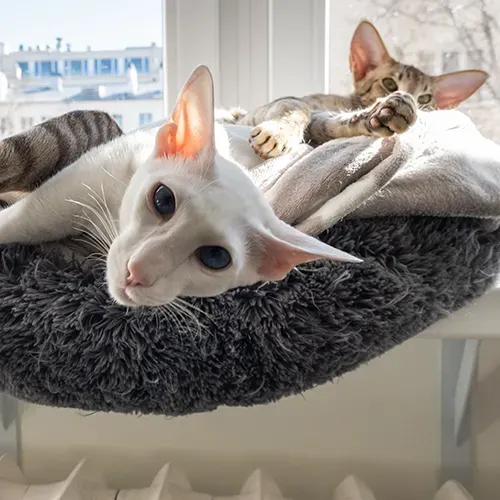
Life with an Oriental shorthair is never dull! They're attention-seeking and will often want to play.
They're highly active, so need lots of outdoor space to run and climb. But you may want to make an enclosure because they can be very stealthy cat burglars and will bring you home prizes from other homes - you don't want to upset the neighbours.
They can be left for a few hours, but will need lots of stimulation while you're gone, or they'll become destructive. When all that energy has been burnt off, your lively friend will become an affectionate lap cat.
Caring for Your Oriental Shorthair
The slim, athletic figure of the Oriental cat breed isn't designed to carry excess body fat. If this breed gains weight, it develops a noticeable potbelly.
To prevent your cat from putting on those extra pounds, make sure you feed them the correct amount. Guidelines can be found on the food packaging. A good quality cat food will meet your cat's nutritional needs. Treats can be used for reward-based training, but don't give them too many.
The Oriental has a fine coat that lies close to the body. They don't have an undercoat, so don't need much grooming. Brushing your cat once a week will remove loose hairs and help to spread natural oils that keep their coat healthy and glossy.
Grooming is a great way to bond, and they'll love the attention. It also gives you a chance to check their ears, eyes, teeth, and nails for any health problems.
Any redness, inflammation, bad odours, discharge, or wax build-up should be checked out by a vet. Your cat will do a great job of keeping itself clean, so you won't need to bathe them unless they're very dirty or smelly.
This intelligent breed learns quickly and can even be trained to walk on a lead. But it's also independent, so doesn't always listen. Litter training is easy; just make sure your cat always has access to a clean litter tray, and they'll be more inclined to use it. Don't keep the tray near their bed, food or water.
Orientals need access to an extensive outdoor space - a secure garden or large 'catio' (cat enclosure) will do the trick. They're great jumpers and love to climb, so give them plenty of perches and cat trees to use.
They're also very playful and appreciate a variety of toys. Recreate hunting for food with interactive treat-dispensing toys. This will provide stimulation and keep them out of mischief... for a little while at least. If your home isn't equipped for this breed, they'll happily climb your furniture and knock your ornaments on the floor!
Oriental Shorthair Cat Insurance
Your Oriental Shorthair is an intelligent and playful little scamp. But those loveable characteristics can also see them getting into their fair share of mischief. That's why it can be a good idea to get them covered with a level of insurance that works for you.
Everypaw's Cat Insurance is built specifically for this purpose. With multiple levels of protection available, you can pick the perfect cover for you and your Oriental.
Plus, with additional benefits like unlimited access to RCVS qualified vets, dental cover, complementary treatment cover and help with finding your special paws if they go missing, there's plenty of reasons to consider Everypaw. We'll even give you a hand when it comes to taking your kitty on holiday, with cover for vet fees overseas anywhere in the EU.
Common Oriental Shorthair Health Problems by Vetstream
Everypaw has teamed up with veterinary experts Vetstream to give you information on the common health conditions seen in the Oriental Shorthair cat breed. They're generally healthy, but can suffer from the same conditions as their Siamese ancestors.
Amyloidosis occurs when proteins are deposited in various tissues and organs, causing dysfunction. Orientals are prone to hepatic (liver) amyloidosis, which can lead to liver failure.
Signs include weakness, distended tummy, pale gum colour, rapid breathing, rapid heart rate, and collapse. There are a few treatment options, but most cats don't survive past one year old. The disease is inherited but can be secondary to chronic infection or inflammation.
PRA is a group of inherited eye diseases that cause the eye to waste away, leading to blindness. Unfortunately, it can't be treated and will affect your cat's everyday life. They'll lose the ability to hunt and won't be aware of dangers, such as moving cars.
But blind cats can live happily in a secure outdoor space and a home adapted to their needs. Luckily, PRA is uncommon in cats.
FCKS is an angular deformity that affects the whole length of the chest, causing the shape to be narrower than normal. Affected kittens won't gain weight at the same rate as the rest of the litter. They won't feed well and will breathe faster and more laboured. You'll also be able to feel the difference in the chest shape. There's likely a genetic element, but the exact cause is unknown. Various treatment options will need to be discussed with your vet.
Bladder stones are made of hardened minerals found in urine. They can form anywhere in the urinary tract and irritate the bladder lining, obstructing urine flow. Stones are often caused by underlying conditions or an insufficient diet.
Affected cats will strain and yelp when trying to wee or will be unable to wee at all. They must be seen by a vet immediately. Urine blockages will need surgery, but if not blocked, some stones can be managed with a special diet.
Quick Oriental Shorthair Q&A
Yes! They're a very friendly breed that thrives on attention and affection. They're also very chatty and will carry on a conversation with lots of meows and chirps. They love meeting new people and will become depressed and withdrawn if left on their own for too long.
No cat breed is truly hypoallergenic, but this breed produces less of the Fel d1 protein that causes allergies in humans. This is why they're often considered to be hypoallergenic. If you have cat allergies, it's recommended to spend time with this breed before welcoming one into your home.
This breed is generally healthy, but it is prone to some health problems. Due to the Siamese in their gene pool, they share many of the conditions found in Siamese cats. This includes hepatic amyloidosis, PRA, flat-chested kittens and bladder stones.
These medium-sized cats are moderate shedders. They do not have an undercoat so shed less than other cat breeds, but you can still expect to find hair on your clothes and furniture. Brushing your cat at least once a week will help to remove the loose hairs and keep your cat's coat in tip-top condition.
The average Oriental shorthair lifespan is between 10 and 15 years, which falls within the normal range for most breeds.
That’s All You Need to Know About Oriental Shorthair
If you're looking for a lively, intelligent and loving cat, the Oriental Shorthair breed is perfect for the more experienced cat owner. Its medium size and playful personality mean they need a home that'll keep them entertained with climbing trees, perches and plenty of toys. They don't like to be left alone for long and can be very vocal. With the correct care and lots of love, this breed could be by your side for 15 years!
Content created by Vetstream Vetlexicon - Clinical content for veterinary professionals
Vetlexicon is the world’s largest peer-reviewed online clinical reference source. All our content is written and peer-reviewed by over 1,000 of the world’s leading veterinarians, ensuring relevance, accuracy and quality.
- Vetstream Ltd (online) Oriental shorthair. In: Vetlexicon Felis. Vetstream Ltd, UK.
- Barber P, Braund K, Day M & Squires R (online) Amyloidosis. In: Vetlexicon Felis. Vetstream Ltd, UK.
- Mitchell N & Gould D (online) Retina: inherited degenerations. In: Vetlexicon Felis. Vetstream Ltd, UK.
- Godfrey D, Verhoeven G & Sturgess K (online) Flat chested kitten syndrome (FCKS) and pectus excavatum (PE). In: Vetlexicon Felis. Vetstream Ltd, UK.
- Taylor S & Watson P (online) Urolithiasis In: Vetlexicon Felis. Vetstream Ltd, UK.


