Our Guide to Progressive Retinal Atrophy (PRA) in Dogs
Vision plays a key role in a dog's confidence, mobility, and quality of life. Because dogs rely heavily on other senses, early signs of vision loss may go unnoticed without careful observation.
There are many reasons a dog may lose its vision, and if you notice signs that your dog's eyesight is declining, it's important to contact your vet as soon as possible. While some causes of blindness can be treated or managed to preserve vision, others, like Progressive Retinal Atrophy (PRA), are unfortunately irreversible.
Although there's no cure for PRA, your vet can offer guidance and support to help your dog live a full and happy life despite the loss of sight. For now though, let's find out more about this condition.
What is Progressive Retinal Atrophy in Dogs?
Progressive retinal atrophy (PRA), also known as Generalised PRA (GPRA), is a group of inherited eye disorders that gradually cause blindness in dogs over time. These conditions affect the light-sensitive cells at the back of the eye, called photoreceptors, leading to retinal degeneration. PRA typically progresses over several months or years, eventually resulting in complete blindness.
There are different forms of PRA, but all result in a slow and irreversible loss of vision. Most are inherited in an autosomal recessive pattern, meaning both parents must carry a copy of the gene for the disease to occur in their puppies. However, cases of X-linked and dominant forms have been reported in some breeds.
An X-linked inheritance pattern means the defective gene causing the condition is located on the X chromosome, which can affect both males and females. However, males are often more severely affected because they have only one X chromosome.
In contrast, dominant inheritance means that only one copy of the defective gene is needed for the disease to develop, and it can be passed on by either parent, regardless of gender. These forms of PRA, though less common than the typical autosomal recessive variety, can present different patterns of inheritance and may affect dogs of certain breeds in unique ways.
How Common is PRA in Dogs?
PRA can occur in over 100 different dog breeds, but in the UK, the most commonly affected breeds include miniature and toy Poodles, Cocker Spaniels, and Labrador Retrievers. Males and females are generally equally affected.
What are the Signs of PRA in Dogs?
The onset of PRA is often subtle. One of the earliest signs is poor night vision, also known as night blindness. Affected dogs may become hesitant in dark rooms or may be reluctant to go outside after dusk. As the disease progresses, daytime vision also begins to deteriorate. Peripheral vision may be lost, leading to tunnel vision.
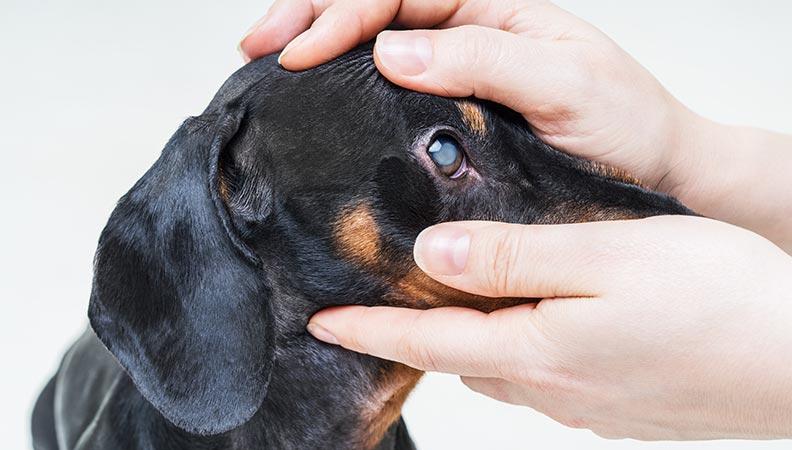
You may notice that your dog has dilated pupils, and their eyes may appear to shine brightly when light shines on them. This increased reflection is often noticeable in photos. Some dogs may also develop secondary cataracts, making the eyes appear cloudy.
While PRA is not a painful condition, it can significantly impact a dog's ability to navigate its surroundings. Signs usually appear in adult dogs, typically between the ages of 3 and 8, although this varies by breed. For instance, miniature Schnauzers may show symptoms at a much younger age.
Retinal Pigment Epithelial Dystrophy (RPED)
Other eye conditions in dogs, such as Retinal Pigment Epithelial Dystrophy (RPED) and retinal dysplasia, can also cause vision loss in dogs, with similar symptoms. RPED tends to progress more slowly than PRA, often affecting central vision, whereas retinal dysplasia involves abnormal retinal development and may lead to retinal detachment. A thorough exam can help differentiate these from PRA based on symptoms and diagnostic tests.
How is PRA in Dogs Diagnosed?
To confirm a diagnosis of PRA, your vet will examine the back of the eye using an ophthalmoscope to look for signs of retinal degeneration. If cataracts or other factors make the retina difficult to see, an electroretinogram (ERG) can be performed to measure the retina's electrical activity. A board-certified veterinary ophthalmologist typically performs this test, and your veterinarian can refer you if needed.
For certain breeds, DNA tests are also available and can be a valuable tool. These tests are simple cheek swabs or blood samples and are especially useful for young dogs or dogs intended for breeding, as they can detect PRA before any clinical signs appear.
PRA testing in dogs can also identify carriers, which are dogs that won't develop the disease themselves but may pass the gene on to their puppies.
How to Prevent Progressive Retinal Atrophy in Dogs
While there's no way to prevent PRA from developing in an individual dog once they carry the gene, responsible breeding practices can help reduce the risk in future generations.
PRA is often inherited in an autosomal recessive manner, meaning both parents must carry a copy of the gene for puppies to be affected. However, it is still possible to inherit the disease from one parent. DNA testing enables breeders to identify affected dogs, carriers, and those that are clear of the disease. Breeding should only be done with dogs that are clear of the PRA mutation to avoid passing it on.
If you're getting a puppy from a breed known to be at risk of PRA, always ask the breeder for proof of genetic testing in both parents. Reputable breeders screen for inherited conditions to help ensure healthier litters.
Is There a Cure for PRA in Dogs?
Although there's no cure for progressive retinal atrophy, many dogs adapt remarkably well to their gradual vision loss, mainly because the condition progresses slowly.
Most dogs will become completely blind, but with patience, routine, and environmental support, they can continue to lead happy, confident lives. It's essential to remember that PRA is not a painful condition, and affected dogs often remain cheerful and interactive.
However, because it's a hereditary disease, dogs diagnosed with PRA or identified as carriers should not be bred to help prevent the condition in future generations.
Everypaw Dog Insurance
Everypaw's Dog Insurance comes with 24/7 unlimited access to vets and vet nurses that can help with your pet's health, care, nutrition and behaviour. So you can rest assured your pup will be well looked after.
Content created by Vetstream Vetlexicon - Clinical content for veterinary professionals
Vetlexicon is the world’s largest peer-reviewed online clinical reference source for veterinary professionals. All our content is written and peer-reviewed by over 1,000 of the world’s leading veterinarians, ensuring relevance, accuracy and quality.
- Gould D, Davidson A P, Williams D et al (online) Retina: generalized progressive retinal atrophy. In: Vetlexicon Canis. Vetstream Ltd, UK.
- Gould D, Williams D & Brooks D (online) Retina: central progressive retinal atrophy (CPRA). In: Vetlexicon Canis. Vetstream Ltd, UK.
- Vetstream Ltd & Gould D (online) Progressive retinal atrophy (PRA). In: Vetlexicon Canis. Vetstream Ltd, UK.
- Morgan R & Mitchell N (online) Retina: dysplasia. In: Vetlexicon Canis. Vetstream Ltd, UK.


